
Still, you need to prepare for your monetization — and choosing the right hosting is one of the important steps. Why does it matter so much and how to arrange it all wisely?
Let’s straighten it out.
Even the best landing page won’t help you earn money if it takes forever to open it. And what if it stops loading at all? The same is true for publishers who are striving to monetize their websites.
These are the issues you can easily avoid if you pick the right hosting provider. Hosting is responsible for your website or landing page's quick and stable work — it’s like a house footing.
A hosting server you use for your site or page must be capable to manage all incoming traffic, and all user requests — 24/7. Any mistakes, delays, or activity breaks may result in losing users: they will barely visit your page again to check if you fixed the issues.
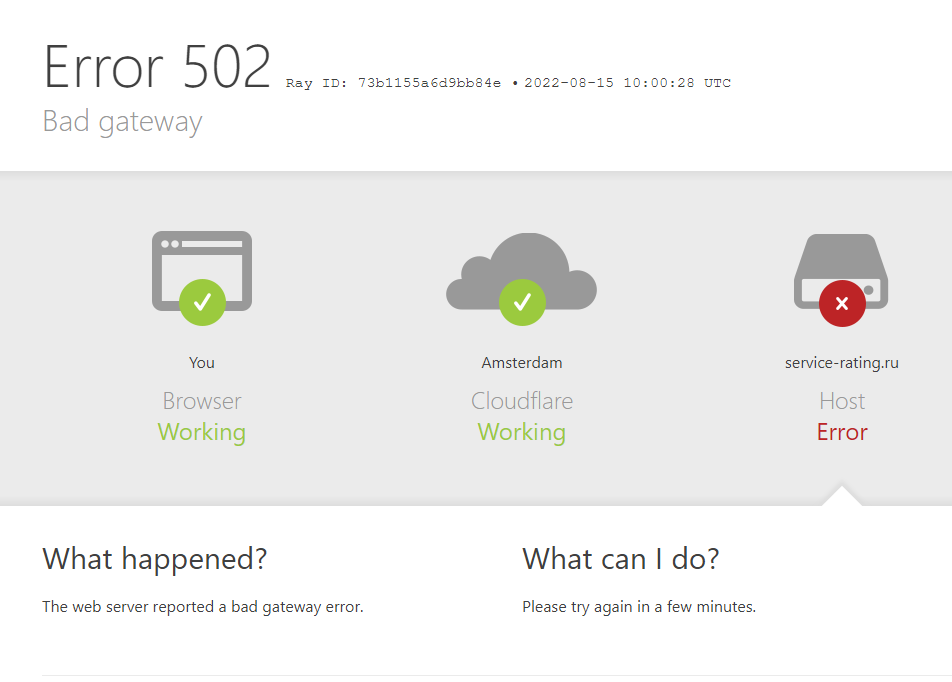
Imagine how much converting traffic you can lose with an error like this?
So how to find the provider you can trust and shall you pay for it?
There are several types of hostings — we’ll look at them in detail a bit later. For now, let’s speak about the two largest groups: free and paid hostings.
We know it’s tempting to save money, especially when you, say, run a very expensive advertising campaign. However, we don’t recommend you save exactly on hosting.
What’s the difference between a paid and a free provider? Look at the table:
| Free Hosting | Paid Hosting |
| -Has many content restrictions -Can be heavily packed with ads | -Works much faster than the free hosting -Doesn’t contain ads |
Let us explain it a bit. Maintaining a hosting server for rent is a pretty expensive business. Here is what a hosting provider shall have:
So, as you can guess, it all costs significant amounts of money. Too significant to do it for charity! This is why all free providers show their ads on pages located at their hostings.
Will your pre-lander for collecting subscribers be really efficient if it’s already full of banners? Will your website stay so user-friendly with a great deal of ads you can’t control?
Besides, a free hosting service will never provide you with such stable and quick work as a paid one can. What is more, you can’t host just any site on a free server: many of them block eCommerce shops, or sales landing pages.
And, by the way, you are not guaranteed that the free hosting service doesn’t have any hidden fees.
This is why ProPush.me accepts websites and landing pages located only on paid hostings. No exceptions!
Okay, you are ready to pay for a server, but it’s still unclear which one to choose. We won’t consider literally all hosting types here: just the ones that will best suit your needs as a website owner or an affiliate marketer.
As the name suggests, dedicated hosting will serve exclusively your website. In simple words, it means you rent a special place for your site and will never share it with anyone else — just like if you rented a house.
Obviously, it’s the most reliable way to ensure quick work and manage large volumes of traffic. Still, you don’t really need it that much if you are an affiliate marketer with a pretty simple landing page.
Another type is the opposite: you share the hosting with the other website owners. Getting back to simple terms, it’s like renting a space in a shopping mall.
Such hosting has particular limitations but will be enough if you have a plain site or a landing page that doesn’t require many resources. It can easily handle about 3k visitors per day.
VPS, or a Virtual Private Server, is something in between Shared and Dedicated hosting.
In a nutshell, it’s also shared hosting, but you have a special private space here — like a fence that protects you from a sudden neighbor’s visit. The other websites using the same server won’t interfere with your processes like they can at shared hosting, and usually allows bigger traffic volumes and higher loading speeds.
You can rent a hosting anywhere — but choose the location wisely.
Suppose you want to run traffic from Brazil, but your server is physically located somewhere in Germany. It will take more time to load your site in this case, so the closer your server is to your users, the quicker your site or landing page will work.
You have two ways of how to deal with a hosting location:
So, as you know your needs, finding the right hosting is not a trouble anymore. But probably you wanted some more straightforward recommendations? Okay, we got them!
Just a little bit more of a theory to sum up — what to look at when choosing a hosting?
And what are the best web hosting companies that can ensure it all? We gathered the top-three popular hosting providers according to the HostAdvice research — and the opinions of our partners.
GoDaddy is one of the top popular hosting providers — it serves 16% of all existing websites. It offers three hosting types:
Although GoDaddy doesn’t offer you any free trial periods, you can claim a refund after the first 30 days. Another advantage is that you can select your hosting location: USA, Europe, or Asia.
Bluehost also has many positive reviews and has established itself as one of the top-recommended hosting providers. It offers the same hosting options as GoDaddy but has a whopping eight pricing plans for the shared type.
What is great about Bluehost, all of its pricing plans include free usage of the Cloudflare CDN, so you won’t have issues with your hosting location.
Ionos claims to be the best hosting provider to react to traffic spikes, with a loading page speed of 1.23 seconds. It also has various pricing plans and a free month for new customers.
We think things got much clearer now, right? Once you choose a suitable hosting provider, it will do its work smoothly — with no distraction from website mistakes.
Or you have everything ready? Why wait then —
Start monetizing with ProPush.me!