![[Case study]: How Desha made $31k with ProPush Constructor in 1 month](https://propush.me/blog/wp-content/uploads/2026/02/propush-desha-case-study-constructor.jpg)
ProPush.me Constructor is easy to set up and integrate, but it doesn’t mean you can launch it and let go. Like any others, your Constructor campaigns need to be carefully tracked – otherwise, you'll know you're getting traffic, but not where it's coming from or what's generating the best results.
Which source is converting? Which one is wasting your spending? Are the clicks real?
To answer these questions, you need an advanced tracker. And, you definitely want it to be easily integrated into your Constructor workflow, so meet Binom – your tool for tracking and optimization with an anti-fraud layer.
Constructor funnels have more variable parts than a standard landing page redirect. Look:
Each of those revenue streams generates a different signal, and you need to tie them to a specific source or zone. Without this breakdown, you won’t be able to blacklist the underperformers and scale what's working.
Binom is a self-hosted tracker built for affiliates running real traffic volume. Self-hosted means your data stays on your own server, not in a third-party cloud, which matters for both privacy and speed.
This tracker is built for performance: redirect times are fast enough not to affect conversion rates, and one license covers unlimited campaigns, traffic sources, and offers.
Briefly, it works like this:
You can break results down by zone ID, subzone, carrier, operating system, or other variables you need. And, you don't need a separate server for the landing page or a manual redirect chain between your tracker and your ProPush.me funnel.
Binom Protect is an optional add-on, and here is how it can help:
Why does this matter specifically for ProPush.me funnels? Because bot traffic doesn't subscribe to push notifications. If bots are clicking through your funnel, your push subscription rate looks lower than it actually is for real users, your zone-level performance data is skewed, and any optimization decisions you make on that data are responding to noise. Cleaning the data at the click level makes every downstream metric more reliable.
The detection system is modular. Binom Protect offers three presets:
Before you start filtering, Research Mode lets you run the detection without blocking anything. You see what was filtered, check that the detection is accurate for your specific traffic, and then turn blocking on when you're confident in the settings.
Tip: Start with Research Mode and Medium protection for 24 to 48 hours, review what gets flagged and why, and then adjust. The Paranoid preset can filter up to 25% of mobile traffic in some GEOs, so testing first is worth the extra step.
The integration runs in five steps. Here's the full flow.
Step 1: Download your landing page. In your ProPush.me personal account, configure your landing page and download the ZIP archive. Before downloading, make sure your APP_CONFIG is set correctly – zones, redirect logic, and domain settings all live there and need to be correct before you upload to Binom.
Step 2: Upload to Binom. Log in to your Binom admin panel, navigate to Landers, and click Create. Give the landing page a descriptive name. In the URL field, select the "No-redirect" option, then upload your ZIP archive. Binom unpacks and hosts the page. After upload, it assigns a path to your lander, typically starting with landers/.
Step 3: Set up a campaign. In Binom's Campaigns section, create a new campaign. Add your lander via the "+ Lander" button. You'll also need to create an offer – any placeholder URL works, because your APP_CONFIG zones handle the actual redirect logic rather than Binom's offer link. One important note: if your landing page can send multiple postbacks for the same click_id (common in upsell flows where a subscriber then converts on an offer), enable the Upsell checkbox in the offer settings. This tells Binom to sum payouts per click rather than overwrite the first one.
Step 4: Add tracking parameters to your campaign URL. Before sending any traffic, append the Binom-provided tracking parameters. The format looks like this:
https://{your_domain}/32ijo?var_1=${SUBID}&var_2={zone_id}&var_3={var_3}
The variables var_1, var_2, and var_3 carry your traffic source macros through to the ProPush landing page and on to redirects. How these maps work inside ProPush.me is covered in the URL parameters guide. Make sure Binom's macro placeholders match what your traffic source actually passes – a mismatch here is the most common reason tracking data doesn't show up in reports.
Step 5 (Optional): Enable the back feature. If you want Binom to log back and exit events from your landing page, open the lander code editor inside Binom (the <> button on the Landers page), find your APP_CONFIG block, and add:
back_pageUrl: 'https://{your_current_domain}/landers/{your_land_name}/back.html'
Replace the placeholders with your actual Binom campaign domain and the landing page name you used during upload. Once saved, back events will fire and appear in your Binom reports alongside subscriptions and conversions.
The full setup is documented at docs-const.propush.me/binom. If you run into a blank page after upload, the two most common culprits are index.html not being in the root of the ZIP archive and APP_CONFIG missing a required field. Check those first before anything else.
Pro tip: If your landing page sends multiple postback events (subscription + upsell conversion), set up the Upsell option in Binom before you start sending traffic. Fixing the payout logic retroactively means reconciling historical data, which takes longer than getting it right on day one.
Binom's tracker license is $149 per month. Binom Protect is an additional $99 per month, and one Protect license covers all your Binom tracker instances. If you're running more than one instance, the per-instance cost drops as you add them.
To start the integration with the ProPush.me partnership, sign up at binom.org/signup?from=PROPUSH.
Start free with PROPUSH promo code: first month free, then 40% off your second month
For documentation beyond the setup steps above, the Binom official docs cover campaign paths, postback configuration, and offer settings in detail.
Anthony has no team – but much experience, data, discipline – and the Constructor. Today, he shared how he grew to a 46.96% ROI over three months.
| February | March | April | |
|---|---|---|---|
| Revenue | $8,317.60 | $26,046.08 | $62,687.16 |
| Profit | $4,415.89 | $6,871.94 | $19,724.83 |
| Growth | – | +213% | +141% |
Anthony answered every question without filters. Here's what he said.
I've been an affiliate since I was 14 – back then, it was just pocket money here and there until I realized how much could actually be made. By 19 I was making $30–35K/mo profit and spending it on cars and holidays. That taught me how important reinvesting is. After a Google algo update hit one of my projects, I used whatever money I had left to move deeper into performance marketing. Since then, I've had success across multiple verticals and niches – and now I'm doing well with the Constructor.
↳ 10+ years of real-world experience. Zero jobs outside affiliate marketing.
I'm not revealing the source – it will directly impact my costs by increasing competition. I have competition anyway and always will, but I'm not going to directly impact myself by revealing it.
What I can say: I go broad when gathering data on something new. It gives you a full picture of what works and what doesn't. Everything boils down to profitability. No fluff.
– What made you try the Constructor – and were you skeptical?
My AM reached out and asked if I'd heard of it – I hadn't. Once she explained how it works, I was hooked. I'm not gonna lie, I was a little skeptical at first. I always like seeing what's possible, so I was asking for rough numbers people were making per month – and I was hooked even more with the possibilities. I trust my AM after a long time working together, so my expectations were good.
What I like most is that there's no offer to be capped or paused. Many times with other verticals, I've spent five figures making something work, scaled it, only to be told it's being paused or capped. Then you have to find an alternative with similar performance, which never works out quite the same. With the Constructor, everything is based on YOU. Not third parties pulling offers or hitting caps.
↳ No caps. No pauses. You control the ceiling.
Start small: $20–30/day. Launch well-prepared campaigns and do NOT touch them while gathering data for at least 3 days. Then go in and check segments of traffic with untouched, clean data and optimize accordingly. I like going broad while gathering data on something new – it gives you a full picture. Everything – geos, landers, headlines, buttons – is just variables in one equation.
↳ 3 days of untouched data before any optimization.
Two letters: AI. AI has been a huge advantage for handling optimization at scale and reacting to performance changes faster than I could manually. AI for me is like having a team – but that team is very intelligent across all subjects. A lot needs to be done manually first. Once the working strategy clicks in your mind, let AI replicate that and optimize accordingly.
↳ AI replaced a whole team of optimizers.
You grew from $8K to $62K revenue in 3 months. What was the actual turning point?
Once you become familiar with what a strong campaign looks like, you can begin systemizing and scaling it. Start with one strong geo and focus on making it work before expanding. The data is there. The rest comes down to execution – and everything is on YOU to make it happen. Once the process becomes repeatable, scaling becomes much easier. That's when I moved the daily budget to $2,000/day.
Never give up. I live by this with everything I do. When I see what others can do and prove it works, it fuels my desire to not stop until I reach my goals. You already have proof that the model works. The rest comes down to testing consistently, gathering data, and improving over time. Don't overthink it – just start, and don't touch your campaigns before the data tells you to.
↳ The model is proven. Execution is everything.
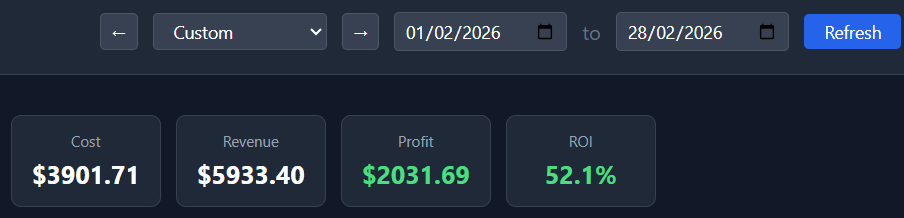
Anthony shared his statistics from his tracker – Optimizer.
February 2026 (Optimizer view)
This case study isn’t about a trending vertical, a special traffic source, or a secret trick. It’s about an affiliate who approached a new product the right way: starting small, collecting good data, using AI to optimize campaigns, and staying patient while the model learned.
The model works. What matters most is how well you execute it.
When I started out in affiliate marketing, I used to run a lot of mVas offers and always enjoyed the process of squeezing out profits on tiny margins. You also get a lot of data to work with which I enjoy!
| Monetization Platform | Propush.me (Constructor) |
| GEOs | Multiple — selected from weekly Propush demand digests |
| Campaign Period | March 1 – April 30, 2025 (bulk of revenue in April) |
| Ad Formats | Popunder (testing) • In-Page Push • Banner • Interstitial (scaling) |
| Device / OS | Mobile only • Android (iOS tested, did not perform) |
| Carrier / Connection | All |
| Budget Range | $20/day start → $1,000–$2,000/day at peak |
| Total Spend | $50,290.42 |
| Total Revenue | $75,231.61 |
| Profit | ~$24,941.19 |
| ROI | ~50% |
⚠️ Actual profit is estimated ~$5K higher than postback data reflects, likely due to missing postbacks and recurring push subscription revenue not tracked in real time.
The testing phase was deliberately low-risk. New campaigns launched at $5/day using the popunder format: fast to load, quick to generate data, and cheap enough to run across multiple GEOs simultaneously without burning through budget.
The core metric at this stage was simple: what CPM is Propush.me returning for traffic from this GEO? That number tells you whether there’s enough margin to buy traffic profitably. If the earned CPM covers your cost with room to spare, you have a viable GEO. If it doesn’t, you move on.
Once a GEO proved profitable, the playbook was straightforward: layer in additional formats. Popunder opened the door; in-page push, banner, video, and interstitial scaled the volume. Each format adds a new traffic pool while keeping you in the same winning GEO.
The portfolio of active campaigns eventually grew to 200–300 running simultaneously. Some of these were micro-earners: generating just a few dollars a day, while others were reliable, consistent performers. The micro-earners had their own value: when CPMs spiked in a geo, they’d pop into meaningful profitability without any manual intervention.
Creatives were split across two objectives rather than optimized for a single goal. Some were designed to maximize CTR, driving raw traffic volume. Others were built to improve traffic quality.
Account manager played a useful role here too — sharing insight into what types of campaigns are running on a given traffic source, informing landing page choices and helping align traffic with what advertisers on the Propush side were actually buying.
This is where the setup diverges from a traditional media buying workflow. With hundreds of campaigns active, manual bid management simply isn’t viable for a solo operator.
The solution was an AI-powered optimizer, built using Claude, that adjusts bids in real time based on performance signals. Weekly geo digests from Propush account managers are fed directly into the bidding strategy, flagging where demand was rising before CPMs peaked.


Without AI I might not have been able to be successful. To launch new campaigns in bulk and optimize them without a team, you need a tireless robot working for you, or an insane work ethic.
❌ iOS traffic failed to deliver iOS was tested as part of the arbitrage setup but didn’t generate viable returns. The entire campaign ran on Android mobile exclusively. Don’t assume iOS will mirror Android performance in this model – test it, but don’t count on it.
The campaign ramped gradually: March served mainly as a testing and learning period, with the bulk of revenue arriving in April once winning GEOs and formats were locked in and scaled.
⚠️ As mentioned above, part of the revenue was not reflected in the tracker/postback data, so while the tracker showed ~40% ROI, the actual final profitability was higher.
| ⚠️ South Africa delivered the highest CPM at $8.65 — nearly double Brazil and Nigeria — despite lower traffic volume. Brazil and Nigeria drove the most impressions and anchor total revenue. Mexico punched above its weight on conversions relative to impressions, suggesting strong traffic quality. Egypt and Peru work best as always-on, AI-managed micro-earners. |
This case study isn’t about a complex funnel or an exotic traffic angle. It’s about a disciplined, systematic approach to arbitrage — lean testing, quality-aware creatives, AI-managed optimization, and steady scaling into proven GEOs. The margins aren’t enormous, but they’re consistent, and the model scales without the usual affiliate headaches. For anyone comfortable with data and willing to invest in the right tools, the Constructor model is worth a serious look.
If you want to thank our partner for sharing his case study, join ProPush.me at his affiliate link
This is the perfect example of where affiliate marketing is moving today.
Recipe
Interested in trying Propush.me Constructor? Reach out to your account manager for top GEOs and traffic source recommendations before you launch.
If you’ve been wondering how the ProPush constructor actually works in practice, Desha’s case study is the perfect practical example.
This is a landing page builder that provides ready-to-use layouts delivered as an archive, allowing clients to edit, customize, and adapt the pages to their specific traffic and monetization needs.
It comes with a pre-set and tested main flow: you choose between landing pages of various categories, each offering an interactive flow.
There are plenty of flows: from longer ones, like Survey, to super-short ones like Player. Here is the full list of what we currently have:

Besides the main flow, each page includes up to 9 monetization zones: classic push notifications, auto redirects, and more. No matter which one you choose, all of them are built to deliver strong results.
All you need is to pick the flow and launch it as is: the default version is fully functional and ready to perform. You can start driving traffic immediately and estimate the results.
If you want to go further, you’re free to change your design and play around with various versions: you’ll get an archive with all the files needed to customize the page for your exact traffic needs.
So Desha tried the constructor with Facebook Ads, and here is what he got.
You can try out the ProPush constructor at Desha’s affiliate link to thank him for sharing: start earning with the Constructor right now!
Desha: What made me excited to try it is that I can easily edit the landing pages to change creative angles to fit my niche.
You don’t actually need to build anything from scratch. Everything is already set up, so you just customize the page to match your audience and start working with your usual traffic sources.
Here’s how Desha did it.
At first, Desha tried the Finance Survey category, but later switched to Clickbox. As he explained, Clickbox fit his creatives and overall traffic strategy better.
Here’s what the default Clickbox landing page looks like:

As the constructor lets you customize the page, Desha made a few changes:

Quick tip from our expert: Constructor is all about flexibility. Updating the wording on the LP is the first and easiest customization you can make to start A/B tests, comparing the default designs with yours. Remember to follow the policy guidelines of your traffic source, though.
Then he set his Facebook campaign like this:
Every day, Desha tested new GEOs and creative angles. The landing page constructor let him change any element of the page, which he actively used – and A/B tested every change.
Below is a landing page example from his Finance Survey category: Desha highlighted the elements he edited to test different GEOs and angles.

The screenshot is provided by the publisher. You can always check actual ready previews at your Propush dashboard.
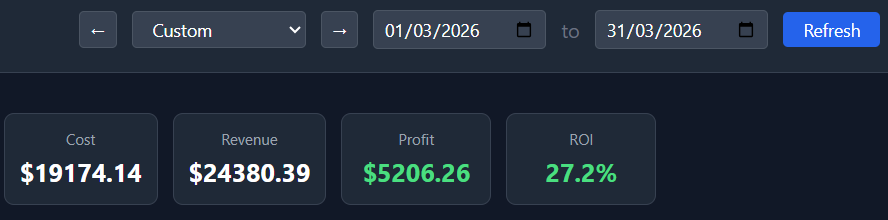
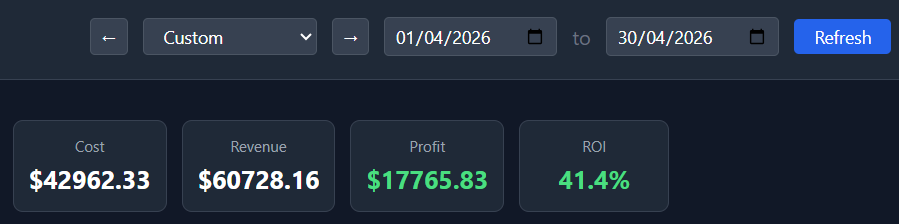
The month passed, and, as we’ve already given away, the results were impressive. Here are the stats from Desha’s ProPush account:

And here is what Skro shows – as he explained it, it shows lower revenue than the actual earnings, as some leads didn’t appear in the tracker:

Can this be scaled? Absolutely. First, let’s give the floor to Desha. Here’s what he said:
There are many ways to scale. The most important thing to understand is that what works for me doesn’t necessarily mean it will work for you. You have to test different approaches and stick with what performs best for your setup.
Once you find the best-performing creative and the highest-volume bid strategy, you can scale it further using a bid cap campaign. It means you set a maximum bid per conversion, so the platform won’t bid above that amount. This allows you to control the maximum cost while you try to increase volume.
What did we see from Desha’s case?
The ProPush constructor lets you save time on building and testing monetization flows from scratch: everything is already set up and ready to go. See how short this case study is? That’s because there wasn’t much to struggle with. Customize, launch, optimize – and that’s pretty much it!
And now, here’s what our expert adds:
Constructor is all about testing and finding what performs best for you with total flexibility on your side. Apart from Clickbox and Finance templates that Desha tested, we offer a variety of templates on the platform with a variety of flows - playable, one-step, multi-step, all come with a strong monetisation engine from us, which ensures that you’ll always have great ROI in your media buying. Also, it works well not only for FB, but for pop, push, and banner traffic. Let’s get it tested!