![[Case study]: How Desha made $31k with ProPush Constructor in 1 month](https://propush.me/blog/wp-content/uploads/2026/02/propush-desha-case-study-constructor.jpg)
Most affiliates know that no campaign lasts forever. What many underestimate is why performance starts slipping in the first place. When a profitable campaign begins losing momentum, the ‘usual’ suspects are easy to identify:
Of course, all of these things can affect performance (and sometimes they really do). Just as often, though, the problem is much closer to home:
The funnel that worked so well a month ago simply hasn't changed while everything around it has.
Every campaign eventually reaches a point where fresh ideas outperform the original version. The goal isn't to wait for that moment—it's to prepare for it.
Your campaign goes live with a promising funnel.
CTR, CR and ROI look healthy, so you increase your budget.
Users become familiar with your messaging while competitors launch fresh angles.
CTR and conversions gradually decline.
Create the next funnel variation before performance becomes a problem.
Your audience has already seen the same headline, scrolled past the same hero image, and they've clicked (or ignored) the same CTA enough times that it no longer catches their attention. Meanwhile, other affiliates are launching fresh pages, experimenting with different angles, and learning what resonates with the same audience you're trying to reach. Every campaign starts with assumptions, and every new version is an opportunity to replace those assumptions with real data.
Now…when you hear “A/B Testing,” chances are you’re probably thinking it’s what you do BEFORE you scale…
Well, if that’s how you play this game – it’s over for you.
Let’s talk about how we keep your campaigns profitable after they’ve already brought you some cash, shall we?
Experienced media buyers rarely think of a funnel as a finished product. Instead, they see it as something that “never sleeps”. Traditionally (and scientifically), for something to evolve, you need to test its angles, dimensions, and limits.
For example, take on the role of assuming one headline will outperform another.
Or a shorter landing page will reduce friction.
Or a different CTA will encourage more users to convert.
All of these are your assumptions, which unfortunately won’t bring you any profit (but will do quite the opposite). Remember yourself back at school, when your science teacher asked you to conduct a “fair test”, by growing 2 different plants in the same liquid?
Yeah… that's exactly what A/B testing is, but for affiliate marketing.
As explained by Coursera, an A/B test (also known as split testing) is a simple way to compare two versions of the same asset under identical conditions. Traffic is divided between the two versions, with only one element changed at a time. That could be a headline, hero image, CTA, landing page layout, or even an entire funnel. Once enough data has been collected, you compare the results and keep the version that performs better.
Same as for plants, huh?
In affiliate marketing, don’t expect to find a perfect funnel on the first try. You’ll have to put in the effort and continuously improve your campaign(s) based on real user behavior (aka. data) rather than “going with what your gut tells you”. Remember that every successful campaign is usually the result of dozens of small decisions that have been tested, measured, and refined over time.
The short answer? Almost always.
You don't have to wait until a campaign starts losing money before running a test. In fact, the best-performing campaigns are usually backed by a constant stream of experiments, even while they're generating healthy ROI.
Running an A/B test is particularly valuable when:
Even a well-performing funnel can often be improved through small details and well-planned experiments. A stronger headline, a more compelling CTA, or a different page structure might not seem like major changes, but together they can have a measurable impact when it comes to campaign profitability.
A better headline. A different CTA. Another landing page layout.
Important: Before running an A/B test, make sure you have enough traffic to generate meaningful results and clear success metrics to evaluate performance. Avoid drawing conclusions after the first 100 clicks – give your test enough time to collect statistically useful data.
One of the biggest mistakes beginners make is testing random ideas instead of meaningful hypotheses. Like really… Every experiment should have ONE clear purpose: finding changes that can genuinely improve campaign performance.
You don't need to rebuild an entire landing page to improve performance. Most winning funnels are simply the result of testing one small element after another.
Start with elements that have the biggest impact on user behavior, then work your way down to smaller optimizations.
For most campaigns, the creative is where optimization begins. Experiment with different formats, visuals, messaging angles, or opening hooks to see what captures attention most effectively. Sometimes a completely new concept outperforms weeks of minor design tweaks. For example, why not try that bold-ass shiny red heading for one of your campaigns targeting SEA?
The same offer can be presented in dozens of different ways. One headline may spark curiosity ("The mistake most affiliates don't realize they're making"), another creates urgency ("Don't let another profitable campaign lose momentum"). Testing different prose doesn't require rebuilding an entire funnel, yet it can have a noticeable impact on both CTR and CR.
Once users click your ad, the landing page becomes the deciding factor. Every editable element (from the headline and body copy to the CTA and page structure) is another opportunity to improve performance through testing.
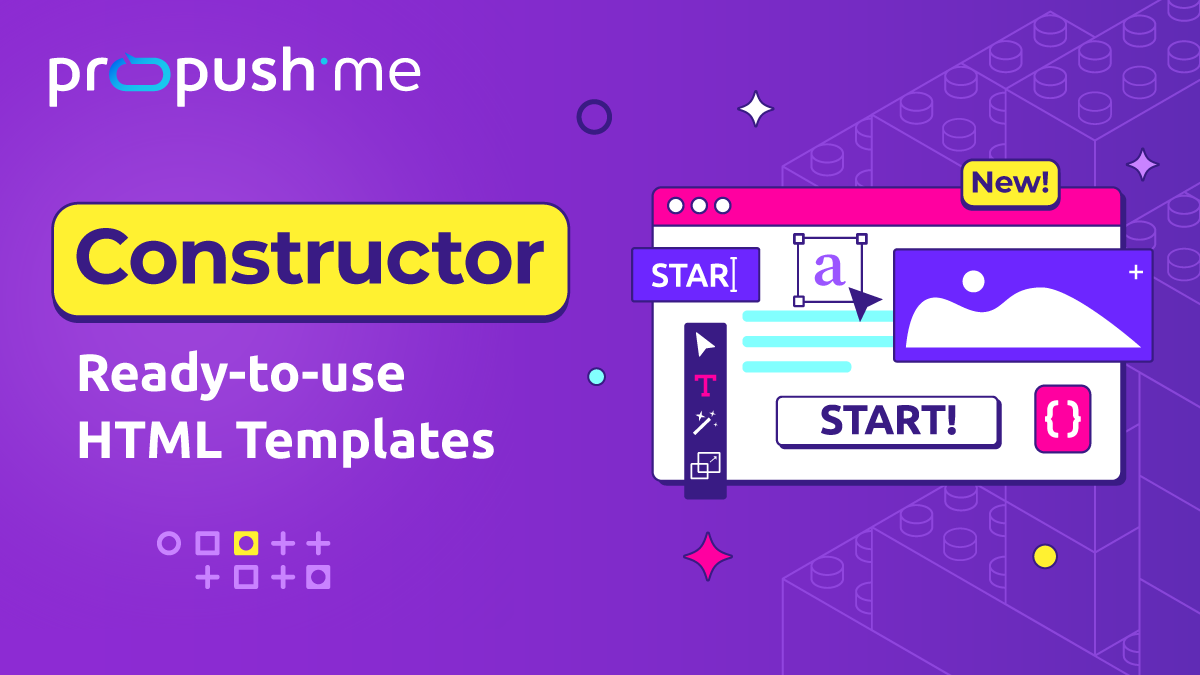
With ProPush Constructor and the built-in AI Assistant, creating a new variation doesn't mean rebuilding an entire funnel. You can quickly update headlines, rewrite copy, modify CTAs, rearrange sections, or customize layouts in just a few clicks, making it much easier to validate new ideas while a campaign is still running.
Even small changes can have a measurable impact. A stronger headline may capture more attention, clearer messaging can improve engagement, and a different CTA might encourage more users to convert. The key is to test one element at a time, measure the results, and let the data guide your next iteration.
Instead of manually managing monetization, ProPush Constructor allows you to focus on improving the parts of your landing page that directly influence user behavior. Since monetization zones are already integrated into your pages, your time is better spent testing different headlines, layouts, messaging, and calls to action that can increase engagement and overall performance.
Testing different headlines, page layouts, messaging, or calls to action often has a much greater impact on overall performance than changing the offer itself. This approach lets you spend less time managing monetization and more time optimizing the parts of your funnel that are directly under your control.
Not every optimization is visible to users. Page speed, mobile responsiveness, redirect logic, broken elements, and unnecessary friction during the conversion process can all reduce performance without obvious warning signs. Before testing new ideas, make sure technical issues aren't preventing your existing funnel from reaching its full potential.
Remember: The goal of A/B testing isn't to change everything at once, but to make deliberate improvements, measure their impact, and build a clearer understanding of what drives results.
Even experienced affiliates occasionally make mistakes that make A/B test results difficult (or even impossible) to trust. The good news is that most of the issues listed below are easily avoidable once you know what you’re doing.
One of the most common mistakes is changing several elements in the same experiment. If you modify the creative, landing page, and CTA all at once, there's no reliable way to tell which change actually influenced the outcome.
No matter how tempting it is to change everything at once, remember to modify one variable at a time (fair test, remember?). That way, every improvement can be traced back to a specific change.
We know how you feel ready to declare a winner after the first hundred clicks, especially when one variation looks noticeably stronger. In reality, though, early results can be misleading.
Give your test enough traffic to reach statistical significance before making optimization decisions. What appears to be a clear winner after a few hours may look very different once more data comes in.

A/B testing only works when both versions are shown under the same conditions (fair test!). If one variation targets a different GEO, audience segment, or traffic source, you're no longer comparing the page itself (you're comparing completely different users!).
Keep your audience as consistent as possible so the results reflect the changes you're testing, not differences in traffic quality.
CTR is important, but it rarely tells the whole story. A creative that generates more clicks isn't always the one that produces the highest revenue. Pay attention to the full picture, including conversion rate, EPC, ROI, approval rates, or any other metrics that matter for your campaign goals.
Sometimes a variation with a slightly lower CTR turns out to be the most profitable once the campaign reaches the final conversion stage.
Avoiding these mistakes won't guarantee that every experiment produces a winner, but it will give you a foundation where you’ll stand with confidence. Once your testing process becomes structured and consistent, optimizing campaigns becomes far less about guesswork and far more about making informed decisions.
A successful testing workflow isn't about using as many tools as possible but trying to remove every obstacle between a new idea and a live experiment. Chances are, you already have everything you need to measure results. Traffic sources provide campaign data, trackers split traffic between variations, and analytics tools reveal how users interact with a page.
But then, what about the bottleneck no one stresses enough?
Building the next version of your campaign.
You come up with a better headline, a different page structure, or another way to present the offer, but turning that idea into a working landing page can easily take longer than the experiment itself. As a result, promising hypotheses stay in your notes instead of reaching real users, and your old campaigns continue eating up your budgets while you procrastinate.
Let’s face it..
Your landing page builder becomes JUST AS IMPORTANT as your tracker.
A good landing page builder removes the repetitive work, so you can spend more time testing ideas instead of rebuilding pages.
Use an existing funnel as your starting point instead of building everything from scratch.
Edit headlines, CTAs, layouts or entire sections to create a new variation.
Create dedicated versions for different GEOs, audiences or traffic sources.
Publish a new funnel variation in minutes and start collecting real data.
Trackers tell you which variation wins. ProPush.me Constructor makes creating that variation significantly easier. Instead of rebuilding pages from scratch, you can start with proven templates, edit any landing page element with the AI Assistant, take advantage of built-in monetization zones, and launch unlimited customized versions while maintaining full control over your funnels. Together, they make continuous testing faster and far easier to sustain.
Concluding, one thing affiliate marketing teaches you pretty quickly is that there are no permanent winners: Not offers. Not creatives. Not landing pages.
The campaign that's bringing you your highest ROI today will eventually lose its edge, and that's perfectly normal. Even BLOCKBUSTER, once a thriving success, eventually became outdated and was forgotten.
The real question isn't if it happens. It's whether you'll have the updated version ready before everyone else outgrows your campaign.
A friendly tip from us: Don't spend your time chasing the mythical "perfect funnel." Build, test, learn, and repeat until the numbers tell you it's time to move on (and then, do it all over again).
If building another landing page still feels like a project you'll "get to later," you're probably testing fewer ideas than you could be. In performance marketing, fewer experiments usually mean fewer opportunities to find your next winner.
That's exactly why we built the ProPush.me Constructor and AI Assistant. Not to replace your strategy or tell you what to test, but to remove the friction between having an idea and putting it in front of real users. Because the sooner a new variation goes live, the sooner you know whether it's worth scaling (or whether it's time to try something better!).